

Last updated: September 2026
Environmental Policy
The future Nifco aims for is “an affluent and sustainable society.” We believe that manufacturing products with consideration for the global environment will serve as a powerful driving force for sustainability.
Basic Environmental Policy
Recognizing that environmental conservation is one of the most important issues for the realization of a sustainable society, Nifco* strives to conserve biodiversity and the global environment across its entire value chain, including its business activities and products.
*Nifco: All companies belonging to the Nifco Group
Action Guidelines
-
We share this Environmental Policy with all employees in order to implement and maintain it. We also present this Policy to suppliers and request their cooperation in environmental conservation.
-
We comply with environmental laws and regulations, ordinances, agreements, etc.
-
We set and implement environmental targets to the extent technically and economically feasible, review them periodically, and strive for the continuous improvement of our environmental management system and the prevention of environmental pollution.
-
We promote energy conservation and the reuse of resources, and strive to prevent global warming and realize a circular society.
-
We strive to reduce all waste generated from our business activities.
-
We thoroughly manage chemical substances contained in products.
-
We promote the development of clean, comfortable and environmentally friendly products, and strive to reduce environmental impact.
-
We promote environmental awareness among all employees, and strive to participate in and support environmental conservation activities.
-
We disclose information on environmental conservation activities in a timely manner and engage in communication with society.
Environmental Management System
We have established an environmental management system (hereinafter “EMS”) based on the international standard ISO 14001.
Since obtaining ISO 14001 certification in March 2001, we have been developing organizational structures, building mechanisms and promoting environmental activities under an EMS linked to our business activities.
With environmental contributions to society through our products and the reduction of environmental impact from our business activities as the pillars of our efforts, we plan, implement, evaluate and improve activities by department through the PDCA cycle.
The effectiveness of the EMS is verified through periodic internal audits and management reviews, and we work to raise the level of our initiatives by making improvements to address issues.
Promotion Framework
We have appointed an Environmental Management Representative at every site covered by the EMS, and each site implements management programs tailored to the specific characteristics of its operations. In addition, management conducts a management review as an annual summary of activities.
In the management review, we evaluate whether the EMS is functioning in a suitable, adequate and effective manner, and identify opportunities for continuous improvement.
The FY2025 management review confirmed that the EMS is being operated in a suitable, adequate and effective manner. We will continue to make improvements so that the EMS can continuously achieve its intended outcomes.
ISO 14001 certification has been obtained by 4 companies (9 sites) in Japan and 21 companies overseas, representing 86% of all Group companies.
Compliance with Environmental Laws and Regulations
We periodically check the status of compliance with the environmental laws and regulations applicable to each business site, and there were no violations of environmental laws and regulations in FY2025.
Developing Expert Personnel
To enhance the expertise of employees who promote environmental activities, we conduct EMS practitioner training. The program is designed to be useful in practice, covering the integration of operations and the EMS, how to run the PDCA cycle, related internal rules and other topics, and 44 employees attended in FY2025.
With regard to internal auditors, we had previously focused on improving the skills of existing auditors. However, in view of the need to develop new personnel, in FY2025 we conducted training for 17 new internal auditors and certified them as qualified internal auditors.
Collaboration in the Supply Chain
Nifco advances its environmental initiatives together with its suppliers, who are important business partners. We have established environmental conservation standards and have requested each supplier to comply with them. In FY2025, as in the previous year, we conducted on-site audits of 3 suppliers, mainly from the perspective of compliance with environmental laws and regulations, and 65 suppliers conducted self-audits. After the audits, each supplier shares its issues and countermeasures with the Company, and we work together to achieve further improvement. In addition, we issued the “Sustainability Procurement Policy” and the “Sustainability Procurement Guidelines” to all Tier 1 suppliers, and obtained agreement from more than 90% of them.
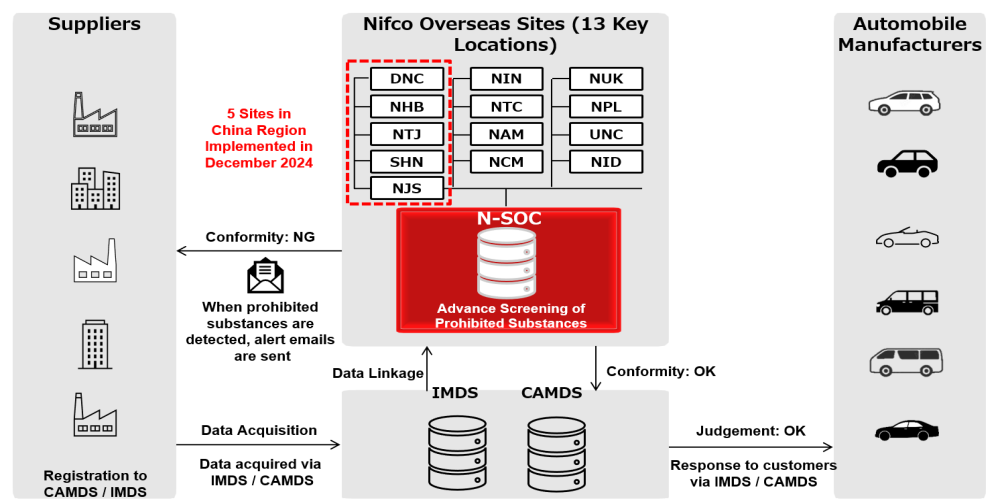
Introduction of “N-SOC,” a Database System for Managing Substances of Concern (SOC), Begins at 13 Major Overseas Sites
The Company was among the first in the industry to introduce a database system for SOC management, doing so in 2004, and in 2018 renewed it as “N-SOC,” completing its introduction at all sites in Japan. For overseas sites, the “N-SOC Overseas Project” was launched in January 2024, and we are introducing the system at 13 major overseas sites. Of these, introduction was completed at 5 sites in the China region in December 2024, and introduction work is currently underway at the remaining 8 sites. A key feature of N-SOC is its ability to link with the composition data of the Company’s products on IMDS* and CAMDS** and automatically verify compliance based on both applicable regulations and customer-specific requirements, further strengthening our comprehensive global regulatory compliance capabilities and quality assurance system.
* Abbreviation for International Material Data System, an international database system for managing and sharing information on chemical substances contained in parts and materials used in the automotive industry.
** Abbreviation for China Automotive Material Data System, the Chinese version of IMDS, used only in the Chinese automotive industry.
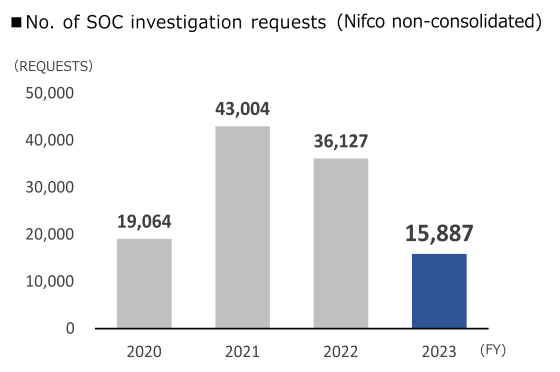
Results of SOC-related Surveys in FY2025
In FY2025, as there were no major revisions to relevant laws and regulations, the number of survey responses totaled 21,311 items (down 44.8% year on year), with activity settling down overall.
On the other hand, we received a particularly large number of requests for content confirmation surveys regarding PFHxA under the EU REACH Regulation, as its application was approaching, and MCCPs under Japan’s Act on the Evaluation of Chemical Substances and Regulation of Their Manufacture, etc. (Chemical Substances Control Law).
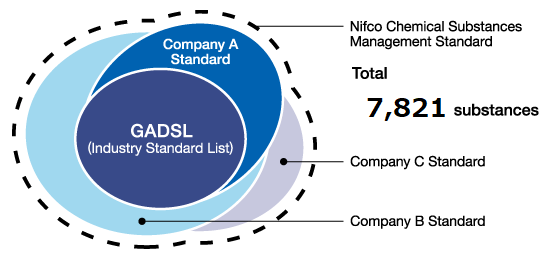
Issuance of the Nifco Chemical Substance List (NCSL) Rev. 8.0
In addition to chemical substances that are prohibited or subject to mandatory reporting under environmental regulations, we also address chemical substances that customers prohibit or require to be reported under their own customer-specific requirements. Every year, we compile all of these chemical substances into the “NCSL: Nifco Chemical Substance List,” and require all suppliers to ensure that prohibited substances are not contained and to disclose other substances subject to reporting.