

2026/04/28
Mizuho Bank, Ltd.
Ishizaka Group
NISHIKI Co., Ltd.
Nifco Inc.
Mizuho Bank, Ltd. (President: Masahiko Kato, hereinafter referred to as "Mizuho Bank"), Ishizaka Group, a cooperative association for the recovery of valuable materials (Representative Director: Takamitsu Ishizaka, hereinafter referred to as "Ishizaka Group"), Nishiki Co., Ltd. (Representative Director: Kazumasa Egami, hereinafter referred to as "Nishiki"), and Nifco Corporation (President & Representative Director: Masaharu Shibao, hereinafter referred to as "Nifco") have commenced joint research aimed at resource recycling of waste (plastics) originating from the semiconductor industry into the automotive industry.
If a resource-recycling business model is established through this joint research, the companies will collaborate to build a supply chain connecting the arterial and venous industries for social implementation.
1. Background
In the Kyushu region, where the semiconductor industry is rapidly accumulating, a diverse and substantial amount of industrial waste is generated. Reusing this waste as a high-value-added resource, rather than simply treating it as waste, is a crucial social issue from the perspective of realizing a circular economy.
Furthermore, the Kyushu region is also a major hub for the automotive industry and given the potential impact of international resource recycling regulations, including the European ELV regulation*1, an increase in demand for recycled plastics is anticipated.
Therefore, this joint research project brings together the strengths of:
• Mizuho Bank, possessing expertise and financial capabilities in the sustainable business field
• Ishizaka Group, with a proven track record in advanced waste sorting technology and recycling chain construction
• Nishiki, possessing compounding technology from raw materials to finished products
• Nifco, renowned for its development-oriented product design, mold making, manufacturing, and product function evaluation
to address the pioneering European ELV regulation and realize a high-value-added circular model for waste plastics.
*1 European ELV Regulation (End-of-Life Vehicles Regulation):
This regulation strengthens circularity throughout the entire lifecycle of automobiles, from design to disposal and recycling. It replaces the previous ELV Directive with a directly applicable regulation that strengthens proper disposal and tracking at the end of a vehicle's lifecycle and extended producer responsibility (EPR). For plastics used in new cars, mandatory use of recycled materials will be introduced in stages: 15% after 6 years of implementation and 25% after 10 years. The regulation also includes a target of at least 20% of recycled plastics coming from end-of-life vehicles. Furthermore, the existing requirement to maintain a reuse and recycling rate of 85% or more on a vehicle weight basis will be maintained and strengthened.
2. Overview of the Joint Research and Future Implementation Details
With the further concentration of the semiconductor industry, the amount of plastic waste originating from this industry is expected to increase. Currently, much of this waste relies on processing methods such as "thermal recycling*2," "incineration," and "landfill."
However, in order to reuse these materials as high-value-added resources, advanced material recycling through inter-industrial and inter-industrial collaboration is necessary. Therefore, this research will explore the possibility of constructing a closed-loop material recycling supply chain based on the "X to Car" concept, assuming connection with the automotive industry in the Kyushu region.
Specifically, the feasibility will be comprehensively verified under the following division of roles.

*2 Thermal recycling:
A method of recovering the thermal energy generated during the incineration of waste (mainly plastics) and utilizing it for power generation, heating and cooling, etc.
【Diagram of collaboration for demonstration experiments】
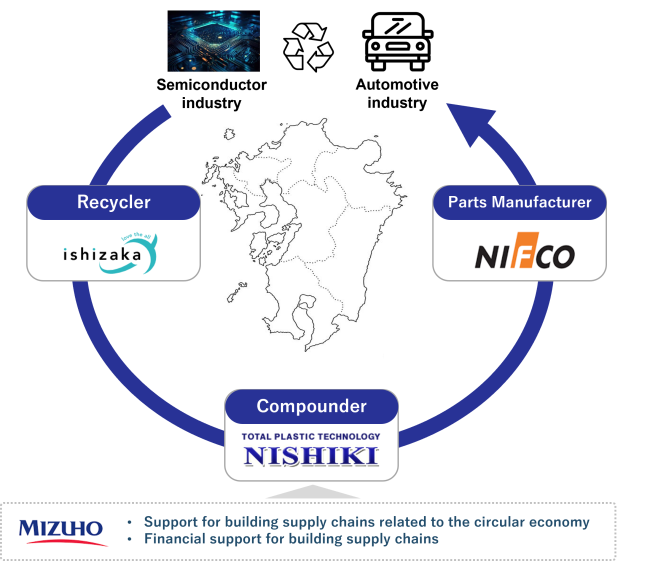
Going forward, Mizuho Bank, Ishizaka Group, Nishiki, and Nifco will continue to focus on the industrial structure of the Kyushu region and promote the construction of a sustainable resource circulation model through regional revitalization-oriented collaboration between arteries and veins.